
I remember driving around Culver City with Ravi in his hatchback about ten years ago—maybe after we had just inhaled some Zooies cookies—discussing what kind of music we wanted to make while I was in town for the week. Ravi quietly, casually tossed off this comment that carried such deep undercurrents of wisdom and commitment: “Whatever we do, let’s make sure it’s dumb.” I immediately felt liberated in ways that continue to reverberate into the present.
Ravi’s paintings inhabit a singular space that is, all at once, playful, menacing, libidinal, dumb, incisive, hilarious, and disturbing. He is a shrewd observer of American culture and politics, with a deeply original vision that interrogates the myriad ways those of us in the land of the free remain repressed and points toward a problematic, idiosyncratic utopia hiding in plain sight.
In advance of “Handholders,” his solo show presented by Dracula’s Revenge and PACE that opens this Friday in NYC, Ravi and I had a wide-ranging conversation about shame and shamelessness, feral cats, Seth Putnam, Lil’ Kim, right-wing counterculture, Looksmaxxing, and assorted orifices.
Jonathan Pfeffer: There’s a deadpan realism to the way you rendered these cats’ buttholes. I love the cat’s menacing stare during an active leak.
Ravi Jackson: I was not self-conscious about what I was doing, in a good way.
JP: Unselfconscious anuses.
RJ: I think the way that [genitals] have shown up in my work before has been kind of accusatory. It’s like Eldridge Cleaver. With Lil’ Kim, I think I wanted it to be more fun. I like Lil’ Kim and what she represents.
JP: I feel like I had an opportunity at your last New York show to engage with Lil’ Kim as a caricature of an imposed cultural idea of Black femininity, but also as a person with her own subjectivity deliberately inhabiting and subverting a sexualized caricature.
RJ: Yeah, she’s very much a performer.
JP: You recontextualized these images in a way where I understand how Lil’ Kim is simultaneously a victim of hegemonic forces, a semi-willing participant in an ugly game, and a countercultural actor, having fun fucking with the system. You let us see the full scope of her humanity.
RJ: I would hope so. I feel like it was meant to start with her as a performance. She’s using herself symbolically and metaphorically in different ways. I guess the goal is to transform [her image] a little bit and present it more honestly. I also just enjoy Lil’ Kim as an icon.

JP: I remember you told me about someone who confronted you at that opening. Was she offended by the way you used the images or just by the inclusion of Lil’ Kim, period?
RJ: I don’t know if she made the distinction. I don’t think she was familiar with that first album where Kim’s posing in lingerie. I think she saw something slightly pornographic and exploitative of Black sexuality. I think that’s a way of not engaging at all with the material. I mean, all this stuff’s present in the world already.
JP: Totally. Also, those images of Lil’ Kim are clearly engaged with the iconography of blaxploitation cinema, which has its own visual language of subversion and reclamation. I remember a lot of rap record covers and music videos from that era intentionally paying homage to blaxploitation films. Foxy Brown is an obvious example.
RJ: Right. I think that, to a degree, I thought that lady’s anger was a good example of how unexamined this conversation is. Maybe the fact that she got angry is a good example of the value of just trying to engage with it as honestly as we can.
JP: Was she white?
RJ: She was. She was a white, middle-aged woman, probably in her 50s, I’m guessing.
JP: Maybe she ignored race and just interpreted the images along gender lines?
RJ: Maybe. I remember she told me that she worked in public arts of some kind. But the last thing she told me was that she would not bring her Black female co-workers to see the show. It’s a very complicated and telling statement to make. I think people who make and install public art, who are involved in the infrastructure of presenting to people outside, think about it in a really different and weird way.
There’s a Tony Smith sculpture I’m obsessed with at Hunter College on 68th street. It’s called Tau. The sculpture was put there after decades of protests in part to prevent people from gathering outside.

I was reading about a lot of A&R reps from ‘90s rap labels like Tommy Boy Records. Chuck D was talking about this niche rap group called Young Black Teenagers that had a few singles and an album. They were actually four white teenagers from Long Island. They were put together as an idea by Chuck D. I think this is emblematic of the show business of rap music.
I think that a lot of times people don’t really think about Black musicians and artifice. There’s a deliberate performance with Lil’ Kim or Foxy Brown. Look at just her name. As you mentioned, that’s a very intentional reference to blaxploitation movies, marketing her in a specific way that was put together by Jay-Z and Roc-A-Fella. For whatever reason, I think it’s very difficult for people to think about how, especially rap music in the context of show business, that they were putting on a show or a performance.
JP: You play with the tension between artifice and authenticity in your work in a way that makes so much sense in the context of rap. To go back to orifices and Seth Putnam, I feel like the buttholes in your paintings are really honest.
RJ: Honest buttholes. Seth Putnam is at the heart of all of my interests, probably.
JP: You even wrote “anus pussyhole signifier” in the press release.
RJ: This is how deeply embedded Seth Putnam is in my brain.
JP: What do you find fascinating about Seth Putnam?
RJ: I think it changes over time. I think I’ve been attracted to his relationship to music and the music industry, which I feel like I’ve tried to model in my own way. I’m interested in Francis Picabia and these other artists who also have an antagonistic relationship – shit-talking, etc. – but also an earnest relationship to art.
JP: Seth Putnam wasn’t an outsider at all; he was a noteworthy figure in a certain scene. Do you think A.C. operated almost on the absolute edge of what it means to participate in a traditional music economy?
RJ: Yeah! When I was in high school, I think it was the only grindcore band that I liked because I thought every other one that I heard was so self-serious and corny. Also, I think they’re just a good band. I think I was also more immune to the hateful language and jokes; they are just part and parcel of what they do. I’d say I’m definitely less interested in their music now. But I do think that when I was in college, I heard they had re-released their first several EPs, which is just like experimental music. I think it’s like 5,000 short grindcore songs.
JP: Populist Dada music! That sounds like it could be a scumbag version of “Coconut Hotel” by The Red Krayola.
RJ: Yeah, he’s a kid from some town outside of Boston. You see this like really earnest ambition, but framed by being a joke. You look at their early performances, and they were very self-consciously a joke, but then you listen to the music and they’re making better music than Napalm Death was at the time. I think this is where my own romanticism comes into play because there’s something interesting about existing on the fringes of the music business or in music, period. And that doesn’t even seem like it was the goal.
The one time I saw them play when I was in high school, it was a total train wreck of a show. But part of it is that it was this big all-day music festival at a time where there’s one type of tough guy hardcore band that incorporated, like, rap-rock elements.
JP: Oh, like beatdown or slam?
RJ: Yeah, there’s this Charles Bronson song that I think is one of the funniest hardcore song titles ever – “One Life Crew Goes On Slimfast.” It’s an inappropriate, fat-phobic joke, but it’s representative of these weirdly specific jokes from someone who’s still an inside player.
JP: I’ll never forget the A.C. song, “Kyle from Incantation has a Mustache.”
RJ: Right, right. Seth Putnam did background vocals on Pantera albums, which makes sense. They have song titles about Discordance Axis stealing their ideas. It’s like everybody knew who they were. There’s the famous show where Hatebreed jumped them on stage, but then apparently got the wrong guy. They thought they were beating up Seth Putnam, but he was just off in the corner of the stage, weirdly. So Hatebreed were just beating up a roadie.
JP: Maybe this is my own romanticism talking now, but hardcore at that time seemed begrudgingly tolerant of deconstruction and critique. I guess that’s what happens when a mature form is right on the brink of collapse. That seems increasingly impossible to do now within any form.

RJ: I don’t even know what that would even mean right now. It’s also about the use of critique. I think Seth Putnam’s critique pissed off Hatebreed, which, to me, is the epitome of a certain kind of New England tough guy hardcore at the time. My friend grew up in the same town as Hatebreed and used to skate with them. He told me a story about how one time he put Iggy Pop on the stereo at the skatepark. The Hatebreed guys were like, “What the fuck is this?” And he was like, [incredulously] “It’s Iggy Pop.” They’re just the dumbest, most ignorant, boring guys in high school wearing Fubu shirts and pooping their pants and stuff.
JP: But not unselfconsciously pooping their pants.
RJ: No, it would be transgressive if they were.

JP: The white cat with the shit leaking out of its ass seems utterly unconcerned about the viewer’s gaze. It feels rebellious.
RJ: I think that’s a part of what I’m trying to reach for. You used the word ‘unselfconscious.’ I think maybe that’s like an exaggeration because almost all cats are pretty private about their bodily functions. I work in Sarah’s studio [in downtown LA] where people feed the stray cats. I’ll walk out at night, and there will be, like, 10 cats, all feeding. They have their own boundaries, but there’s also a kind of promiscuity.
Cats always kind of show you their assholes, but it has nothing to do with sexuality or shame or kink or transgression, you know? But there’s an openness in that gesture – it’s not exclusive to cats – that I feel like is really hard to get to in art.
JP: You have me thinking about the questions of control embedded in the anal stage of psychosexual development where the central conflict is around parental demands. Lacan talks about it as the stage where the subject submits to the Other’s desire.
I see a recurring theme in a lot of your work around secrecy and intrusion. There’s an element of obfuscation that always has a disquieting effect on me.
RJ: Yeah, I think physically, for sure. I think that idea of obfuscating or hiding something, concealing the revealing, I think maybe comes from working with images. I think it speaks to how we see culture. I feel like we’re talking about the presentation – the ostensible, the show – then the latent meaning or how things might work latently or unconsciously.
JP: I see overlap between what we’re talking about here and popular cultural depictions of Black sexuality, which have historically been quite pornographic. There’s a queasy tension between this idea around the ready availability of Black sexuality – to say nothing of the ubiquity of porn – that obfuscates shameful national histories and, obviously, the individual humanity of Black people. You deconstruct these various cultural layers to expose the potential for a truly radical sexuality that could exist outside of shame.
RJ: Yeah, that’s interesting. If we could imagine, say, a butthole without any of these social or cultural connotations, or layers of understanding, maybe that’s what I’m trying to move towards, especially with the cats.
Here are two things I think Lil’ Kim is doing: I think she’s very obviously playing with all of what we talked about – all these ideas about Black sexuality, about how it’s used in advertising, media, how people think about it, all this stuff. Then, like you said, I think she’s inhabiting it in a way that I think is trying to – and maybe for some people it succeeds and others it doesn’t – but it’s trying to show some form of agency, and what that could be like restructured outside of this larger conversation. That’s a part of maybe why I was interested in using the album, because I feel like there are other things you can’t really explain, which is just loving the music.

JP: I read the cats in your paintings as feral or strays. It makes me think about how the only possible way you could expose your butthole and sort of disentangle yourself from all these different layers of culture and shame, etc., is to live completely outside of society. If you participate in society, even at the most marginal level, you are still subject to these assorted unconscious pressures; you’re never totally unburdened from the bounds of culture and society.
Something I think your work articulates and interrogates beautifully is a notion of Black sexuality as an embodiment of the American id, but also playing with the uncanny valleys that pop up in a cannibalistic cycle where rebellion is co-opted, processed, regurgitated, reclaimed, and reinterpreted by the culture. The circle of life.
RJ: We create abstract categories for the sake of understanding, but also then as things get swallowed up by the center of the hegemonic circle, they get reinterpreted and repurposed. I think with this larger conversation about Black sexuality, it’s maybe inherently dangerous because it is always threatening or inappropriate in the sense that it was illegal for white people to have sex with Black people for most of this country’s history. Black men and women are thought to be sexual dynamos that will have sex with anything. In a lot of countries, slaveholding history didn’t really have anything to do with Black sexuality, right? Black women in particular could not be raped legally.
So, I think in that context, trying to talk about agency in terms of Black women’s sexuality, I think is inherently restructuring, right? It’s kind of inherently radical where you talk about just the idea of Lil’ Kim being the agent, not just of her individual sexuality, but of its presentation and interpretation – how she performs it. I think that is taken out of the context when you think about it as an album that is part of showbiz. Hopefully, in the art that can be emphasized. Maybe I’m also just using it because I like it; I think it’s cool! [laughs]
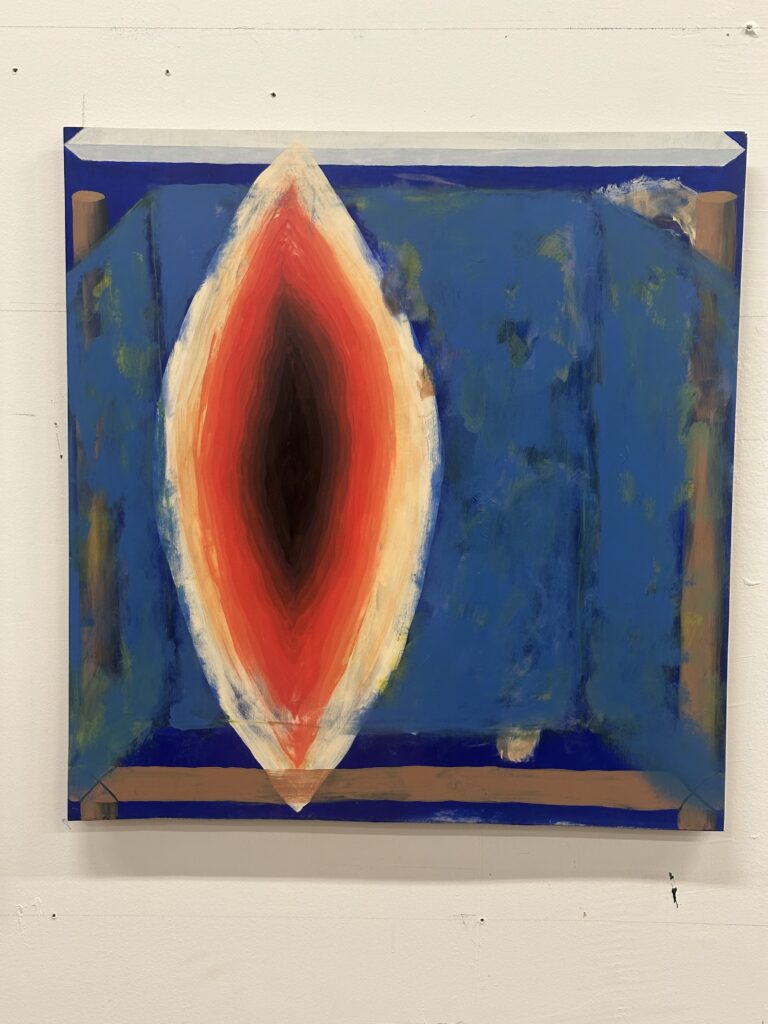
But I think there’s also something in taking symbols of sexuality, nudity, cat buttholes and vaginas. Some of the vaginas in the show are from these illuminated manuscripts from the 1300s, which I think interested me because I thought the image was cool, but also just the idea that this was, again, an idea of sex that is largely divorced from usual conversations or ideas we have about a vagina in Western history.
There are images of Jesus Christ giving birth to the church out of his vagina side-wound. It’s really kind of crazy. What if you see it out of context? It’s also not sexual or how we generally think about sexuality, especially as a sign of women’s genitals, you know?
JP: Now you have me thinking about A.C. as simply a non-sexual combination of orifices – is it just a reference to a vagina that resembles an anus?
RJ: We’re obsessed with orifices for various reasons – a lot of it being Freudian in nature. The vagina or vulva, and the eyeball and the anus. There’s that Buñuel film where the eye’s cut open. They thought of it as the locus – something that could be originating – and the receptacle, but also the divine and, you know, where poop comes out or, like, a penis goes in. It’s ultimately earthbound and fully material.
Seth Putnam is both more literal and abstract about it, but it’s also like a dumb joke, you know? I think that’s what I’m attracted to. [My use of holes] is a way of taking it really seriously, which I think is good until you start to confuse that with practice, or trying to find truth. I’m not anti-truth, but I think I also want to appreciate that this is also a fun game that can be enriching and great on its own terms.
JP: Your work engages with transgressive themes so playfully. When you told me about that pearl-clutching public arts worker at the New York show, I got excited on your behalf because I know you weren’t trying to offend anyone. I still don’t buy her explanation of why she said she was offended. But you’re also not naïve about how charged these images are, and how people might receive Lil’ Kim or a shitting stray cat in a gallery context. You and Seth Putnam both have some awareness that you’re playing with fire to some extent.
RJ: I can see that. The first few A.C. EPs, there’s a way that it is still ultimately about the music. I am aware, but I’m also at times maybe a little bit less aware that I’m working with things that are charged. My goal is never to offend. I don’t think holes, genitals, or poop are even that offensive. In an ideal world, or the world that I would like to work towards, I don’t see these as such charged images. Let’s say that person who got offended, I feel like she would be able to have an earnest look at these images and say, “Oh, I see images like this every day. Why am I angry now?”
There’s maybe a little bit of incredulity that I have about the whole thing. My goal is not at all to make things that are shocking. I really don’t think these are shocking at all. But I do think that a big part of the paintings – this does get lost in conversations with people about my painting in general – is that I’m also trying to make a good painting. Like, a good-looking painting in a particular way. I think that can be obvious in a simple thing like color, for instance. I’m making formally good work; I want it to be satisfying to look at. It’s a weird thing to say because it’s such a vague word, but I’m not trying to make something bad. I think a part of it is there’s a little bit of raising the ante. I’m asking myself, “How do I make a good-looking or pretty painting with a cat’s asshole,” you know? I don’t see these two ideas as necessarily at odds with each other.
I was talking to a student about this recently. It’s hard to explain what makes a painting look good. I’m conscious of the colors I use, but also the kinds of vaguely pattern-like painting I do at times – the kind of decorative objects that I use in the work that make specific references to the everyday. It’s prosaic stuff from Home Depot that is meant to beautify. Much like the gold in the White House now, which was meant to beautify in a class-specific way. I feel like that’s easily digestible and understood. Most people can recognize a Home Depot fixture, and you can know that it’s meant to look good as a part of the function.

JP: I enjoy how you incorporate low-res inkjet web browser screenshots into a lot of your paintings. Some of your paintings still make sense to me on some level in the context of post-impressionism; I could imagine a piece of yours hanging next to a Cézanne or a Matisse.
RJ: I’m going to make a pretty tortured metaphor between paintings that are much better than mine. With Matisse, there are no cat buttholes. But there are cats in Manet’s Olympia. The crisis of the painting is not because it’s so extreme by today’s standards, or arguably even by 1880s standards, it’s because it’s painted in a way that’s so material-heavy. The flattening of the subject and the way it’s so straight-up about the subjects it presents where maybe it wasn’t so polite to show a painting of a pretty ordinary sex worker. I think a lot of the conversation about the painting since then has been about the relationship between how it’s painted that way, where it becomes less about illusion and more just like heavy fucking paint.
JP: Picasso painted so many sex workers.
RJ: Totally. I think by the time that Picasso’s on the block, it was less of a new thing. But again, it’s like incorporating these things from life that I think are ubiquitous, but still maybe even still too blunt. In Picasso’s time and in his social circle, it was a very normal thing for men to have sex with prostitutes. That was just a part of what happened, and a part of the work is interpreted as being about the fear of both immigration and new diseases.
But it was not a thing you talk about at the salon, you know? It’s not something that would be the subject of a serious painting. In some small way, the relationship I have with these paintings – and maybe this is where I compare it to a Cézanne, which is also a dumb comparison – but one thing I love about some of those Cézannes is the weirdness of continuously looking at an apple for 10 hours. It’s such intense observation, and so unsparing that it can make the most mundane thing look a little bit ecstatic.

I’m not going around showing people photos of cat buttholes, but in the studio, these types of images are ubiquitous, right? Like, we all know what gooning is even if you’re not a person who looks at pornography. If you use social media, for instance, or even use the internet, we all get these images that are kind of about pornography all the time, that reference pornography. You’ll see ads that aren’t so different from the collages that I make.
JP: Do you think the value of the butthole as an icon or symbol has gradually fallen over the past 20 years? At least in the West, I’m not sure if it’s the taboo site it once was. Would anyone squirm if a group decided to call themselves the Butthole Surfers now? The Internet really demystified anuses.
RJ: Totally. I think because of pornography, and just the nature of the images that we all see, it strains the suspension of disbelief even further. It’s like clothing in general, especially women’s clothing. This is something that’s been read about a lot by feminist writers, but women’s clothing is not about hiding the body; it’s both about concealing, but also about emphasizing. It’s meant to literally cover, say, the breasts, but also display and emphasize them. There’s a weird tension between things that are always present. I also think porn has kind of just spun into hyper-speed. This association we have with the way that we sexualize bodies and the connection between, let’s say, sex between people and walking down the street. I’ve seen people looking at porn on their phones in public. I don’t mean to be moralizing about it at all, but I just think that there’s a strange fantasy about this stuff.

JP: A Daily Telegraph reader might say that privacy doesn’t matter if you have nothing to hide. You’re touching on a chaotic flicker between ubiquity and privacy. I mean, literally every human being has a butthole. Well, maybe a few people don’t.
RJ: I think I saw a guy on Maury in the ‘90s who was born without a butthole. Almost everybody.
JP: And yet he still felt compelled to show the world his butthole. What you’re saying reminds me of this widespread resignation the culture seems to have about privacy. Your paintings obliterate modern notions of inside/outside (stray cats) or internal/external (shitting), but you’re also questioning whether a free-for-all is actually that radical. The act of shitting as both a material process of externalizing the deeply internal, and a metaphor for the alchemical nature of art.
RJ: Totally. Something I think about a lot because I’m so online is the way the TikTok algorithm works – people are incentivized to sell something. You’ll see people make totally unrelated videos where at the end, they’re like, “Here’s this toothbrush I’m selling in my TikTok shop” because it will boost their video. This has always been the case, but I think it really solidifies how comfortable people are, and how they’re incentivized. I mean, the former being more important – with monetizing and making an intimate piece of their lives about this market transaction, and blasting them all over.
I watched these videos by this thirty-something blonde lady from the L.A. area who made a TikTok series about her bad luck trying to find a husband. She’s gone to see fortune tellers and put out ads, but then there was an article written about her and she went viral. I was watching those videos and wondering, “Why would you talk about this?” I guess people care.

JP: On some level, I think we’ve been dancing around a conversation about shame, which is mostly what I find myself holding for people in my work as a therapist. There are endless questions about what makes a private space with an engaged, non-judgmental witness you don’t know outside of the therapeutic frame so important. One easy answer is that the private container should, in theory, function as a refuge from judgment; even the most compassionate of us still carry attitudes and biases that can inhibit the potential to get to a deeper truth.
I worry a bit about how many truly private spaces are left in the world. I’m troubled by grotesque trends I see in the mental health field, largely related to social media and A.I., where expectations of privacy have become far too loose for my liking. I don’t think we’ve quite moved beyond this moment where people publicly frack their suffering for symbolic capital.
I see such an obvious correlation between the erosion of privacy and the degree to which modern society is so inhibited and repressed. Yet we have access to an infinite expanse of butthole JPEGs to fool us into a false sense of freedom. I wonder if you’re pointing toward how some forms of shame might actually be necessary. Maybe you’re showing that shame can be healthy without invoking a prescriptive moral framework — that it’s about recognizing thresholds and limits rather than about being right or wrong. But I don’t see your work as moralizing; there’s no subtle implication that the cat should wear a diaper. I think these paintings are about freedom in a way that reminds me of Philip Guston’s late work.
RJ: I think you’re putting things much more succinctly and better than I am. But I guess I’d agree. First of all, a part of what I’m thinking about with the cats, for instance, is looking at and painting them as if shame didn’t exist – as if that just wasn’t an issue on the table. I think it’s about having this be as expansive of a painting as the show requires. It only helps to widen the scope of these ideas – no pun intended. What you’re framing seems like a really interesting question. By default, I don’t think we should feel ashamed. I completely relate to what you’re talking about in terms of the necessity of private spaces to house and work through the shame that you feel.
What I see in public now is not necessarily a byproduct of shamelessness. There is a viral video of a guy who made a name for himself on TikTok as one of those “name-and-shame” guys who lives his life in public, like, “This guy said the n-word” or “This guy went to a store and acted rude.” “Let’s find the guy” type of thing. On Thanksgiving, he talked about how he kicked his mom out of the house. He was crying, “She was a narcissistic parent who beat me up.”
I don’t know if the issue is that he needs to feel shame – there’s a version where he did nothing wrong. But TikTok is where it’s being housed, which then invites judgment. It then becomes about negotiating how this is adjudicated in public, and mediated through these random audience members who aren’t really a party to this in a real way at all. That, to me, is still about shame, but I think for someone who, let’s say, has a lot of followers or viewers, it becomes not about trying to deal with your feeling of shame, which I think is a large part of how it might play out privately. Instead, it’s about getting your shame or your actions validated about the shame absolved without any responsibility. Again, it has nothing to do with whether this person’s right or wrong in this situation. This is not a world where we have healthy ways to deal with shame. It seems bizarre.

JP: I agree – it’s bonkers. To shift us back to your paintings, I think the dynamics in your work around secrecy and shame point to something profound about the way individual Black people are stigmatized and scapegoated into taking responsibility for a much more obvious national shame that has, and will most likely, never be meaningfully acknowledged.
RJ: Most attempts to reckon with slavery have failed and mutated. Not just slavery, but I think you see it play out similarly with looksmaxxing. Let’s say you’re a straight guy, and you feel like you’re losing out in the social marketplace. You have anxiety about how romantically unevolved you believe you are, and the fact that you might be implicated in the shame that that entails, I think is immediately rejected. It’s then deflected and projected into accusations. That’s how you end up going from an incel-style self-loathing where the hatred of women becomes part and parcel of that. I see the same thing play out around, for instance, the fear of teaching slavery in schools.
JP: Different strategies that people employ to defend against the same core anxiety of emptiness.
RJ: There’s this essay by Alexis de Tocqueville from when he first visited the US where he talks about the amount of drinking that Americans do and also that America has become “Blackened.” In other words, the proximity to Blackness has indelibly shaped the culture in the U.S., and he doesn’t recognize it as European-descended anymore. It’s a different thing, which of course is tinged with his own racism. It’s a very interesting observation about how, not that long after independence in a really nascent country, he cannot relate to American culture kind of at all, and doesn’t recognize it as Western in a sense.
JP: Shame marshals us into these codified ways of existing and relating to one another. Do your paintings of cat buttholes that resist commodification represent an elegy for the death of ‘60s-style radicalism?
RJ: Yeah, part of it is about documenting my relationship to Blackness and counterculture, where they intertwine. But it’s also kind of trying to reckon with things that I think are good, which have some kind of aspiration. There are also parts that are fundamentally flawed and that I want to leave behind. But it’s also about recognizing that these are maybe part and parcel of the same sphere or object.
Maybe a part of my attraction to the way that beauty becomes a part of the work is that I do feel like the dream of radicalism or counterculture – and I think American counterculture in particular because it’s so untethered from reality – is like one of the more hopeful iterations we’ve had in the 20th century. It’s so bizarrely utopian, and the way it plays out in the world is so fantastical sometimes.
JP: I appreciate your utopian impulse to imagine a fantastical, seductive surface divorced from a core shame.
RJ: Yeah, the fantasy is still there. That’s also part of the work; it’s not possible. I was thinking about the Weather Underground, and the kind of boneheaded way they went about everything. Most of them were from upper-middle-class families, which undoubtedly has to do with the lack of sophistication and utopianism that they engaged in. I think of them as being quintessentially American in that way, with almost no real goals, but tied ruthlessly to the idea of a perfect world and real revolution.
There was a fantasy that during the 20th century, there was a set of issues to work for and against. We just haven’t had that for a long time, so what artists are faced with is the cynicism of working with or against the market. Or just looking inwardly, without any sense that you’re working with or against any kind of community, or some larger conversation. I think it’s a pretty bleak state of affairs for art.
JP: Your work is critical – often self-critical – but it never feels reactionary to me.
RJ: I think a lot of right-wing art is really obsessed with transgression. They have a weird series of diagnoses about what exactly is mainstream culture. I think it can kind of be whatever you want.
JP: I remember us texting about Roseanne’s song with Tom MacDonald [Canadian MAGA rapper] that popped up after the last election. I think the premise of the song is to taunt some Fox News archetype of a left-wing coastal elite schoolmarm who tried and failed to impose shame on what the right wants to uncritically celebrate. The fact that they’re doing so while playing with some mutant interpretation of Black cultural ideas – I have a memory that Roseanne had cornrows in the music video – kind of encapsulates everything we’ve been talking about.
Americans seem to feel so threatened when they perceive criticism that is just someone gently reminding them that they’re not the only people who exist. It certainly makes for a brittle society where people experience an awareness of others as an infringement on their inalienable rights.
RJ: In the U.S., freedom is always defined negatively. Like, you’re more free if you have the right to break the rules, or if you have the right not to do something. There’s also a version like positive freedom, where you have the right to participate, the right to go to school, or the right to healthcare. Whereas in the U.S., you have the right not to be forced, not to have it mandated to go to the doctor. I think that ends up in a very lonely place where the neoliberal fear is of the world imposing its beliefs on you, or its laws or rules.
When you see people trying to be transgressive, they still seem very invested in a sense of bourgeois propriety or ethics. Not that I am somehow free or unattached from those ethics in my personal life, but in the work, I would hope to imagine something that is just not about that kind of moralism, and not about bourgeois-like transgression. It doesn’t accept that sense of propriety in the first place.
JP: Buttholes that aren’t beholden to laws.
RJ: Yeah, just lawless, pre-language buttholes. Pre-discursive, totally unmoored from any kind of discursive judgments, exploding in the wind…

Ravi Jackson (b. 1985, Santa Barbara, CA) lives and works in Los Angeles, California. Jackson received an MFA from the University of California, Los Angeles in 2016 and a BFA from Hunter College in 2012. Solo and two-person exhibitions include South Willard, Los Angeles (2024); David Lewis, New York (2023); PAGE (NYC), New York (2022); and Richard Telles, Los Angeles (2017). Group exhibitions include David Lewis, New York (2024, 2022, 2021); Stars, Los Angeles (2023); Gordon Robichaux, New York (2023); Various Small Fires, Los Angeles (2022); PAGE (NYC) at Petzel, New York (2021); Nordenhake, Oslo (2021); Office Baroque, Belgium (2021); and Matthew Marks, Los Angeles (2018).
Jonathan Pfeffer (b. 1986) lives and works as a psychotherapist in Philadelphia, Pennsylvania.
Leave a Reply